This is a view from my car's GPS system. It's from the county my father was born in, a county he traveled in another time as the sheriff. He knew these roads without GPS and maps, in daylight and in the wee hours of the morning when there were domestic disturbances usually involving alcohol.
I live here now, traveling highways as familiar to me as the sound of a friend's voice on the phone. In all my life, I've never heard the name "Vinton," which you'll see in the lower right-hand corner. It's only 10 miles or so from my house, but I've somehow missed it in following just the well-known Highway 50.
We live, according to this map at any rate, in the middle of nowhere. No congestion. No air quality issues. No long, frustratingly inching commutes.
On the other side of that, we have few high-end restaurants, no movie theater, no mass transportation, no neighborhood groceries,, and certainly no international airport.
What we do have is history. We know each other and each other's parents and children. We pull together in crisis, flocking to each other with casseroles and pies. We take care of aging parents and ailing family members. We share stories and triumphs. We take pride in our parks and walking trails, the beauty of the space around us.
It is not a pastoral utopia, by any stretch. Even in the middle of nowhere there are crime and drugs, abuse and neglect, and there is loneliness. There's the foul rag and bone shop of the heart beating strongly.
I've lived in much larger cities, but I choose here. Here in the middle of nowhere I find there's much left to learn.
Thursday, July 22, 2010
Monday, July 12, 2010
The beauty of 'beauty' parlors
In the South, they never were--nor will they ever be--'salons.' They're beauty parlors. Salon sounds just a tad, oh, stuffy and pretentious.
But call it what you will, we don't really go there in search of beauty. In these chairs, there's therapy and conversation, shared dramas and shared recipes, women who feel secure in letting someone see them at their absolute worst, and yes, the hope that we'll leave looking at least respectable.
Here, you're among friends who don't care that you're sitting right there in public with Saran Wrap matted to a wet head or have a plastic cap tied securely under your chin with just enough hair sticking through tiny holes to make you look like a scurvy survivor.
Here, you can expose your ugly feet for a pedicure, you can burst into sobs five weeks after a hysterectomy and wail, "I'm never going to get better," and no one blinks an eye. They've seen every mystery hair that sprouts on an aging, ever-sagging face. They're tender with longstanding customers who arrive on walkers, unsteady and not quite sure they recognize old friends. They discreetly disguise the thinning patches of once-thick tresses.
Sure, there's every known elixir for hair or face here, and we optimistically cart them home with us. But that's only a cover for the real reason we keep standing appointments at the beauty parlor.
Their talents are with us through every passage. The tense piano recitals, the magic of first proms, the graduations, engagements, weddings, and parties. And there comes a day when you have to pick up the phone and ask, with tears in your voice, "Can you please do my mom's hair for her funeral?" They'll go on a Sunday for that sad, final hairdo.
Especially then you realize the difference in a parlor and a salon. One's an image-maker. The other's with you right up until the end.
But call it what you will, we don't really go there in search of beauty. In these chairs, there's therapy and conversation, shared dramas and shared recipes, women who feel secure in letting someone see them at their absolute worst, and yes, the hope that we'll leave looking at least respectable.
Here, you're among friends who don't care that you're sitting right there in public with Saran Wrap matted to a wet head or have a plastic cap tied securely under your chin with just enough hair sticking through tiny holes to make you look like a scurvy survivor.
Here, you can expose your ugly feet for a pedicure, you can burst into sobs five weeks after a hysterectomy and wail, "I'm never going to get better," and no one blinks an eye. They've seen every mystery hair that sprouts on an aging, ever-sagging face. They're tender with longstanding customers who arrive on walkers, unsteady and not quite sure they recognize old friends. They discreetly disguise the thinning patches of once-thick tresses.
Sure, there's every known elixir for hair or face here, and we optimistically cart them home with us. But that's only a cover for the real reason we keep standing appointments at the beauty parlor.
Their talents are with us through every passage. The tense piano recitals, the magic of first proms, the graduations, engagements, weddings, and parties. And there comes a day when you have to pick up the phone and ask, with tears in your voice, "Can you please do my mom's hair for her funeral?" They'll go on a Sunday for that sad, final hairdo.
Especially then you realize the difference in a parlor and a salon. One's an image-maker. The other's with you right up until the end.
Tuesday, June 29, 2010
Drawn to the Delta
Why would anyone love it here? It's flat, it's hot, and it harbors mosquitoes the size of a baseball mitt. Historically, and now perhaps even more than ever, it harbors poverty juxtaposed by sometimes extravagant wealth. It is a land of unforgiving extremes. My mother's family migrated here long before my memory. Down through Appalachia, down through the foothills of Alabama, where they settled for a while near Mentone, into the anonymity of a small bayou community called Pace. They scratched a living by being salesmen and homemakers, contracting tuberculosis in the case of one grandparent, and mothering 12 children in the case of the other. My mother was one of the 12, born in the year of the Great Flood of 1927.
The older ones--of which there were many--shared their resources and their love with the younger ones. They took each other in. They took nieces and nephews in. They worked hard. They studied hard, valuing the benefits of a hard-fought education then denied to many. They passed on a musical talent that runs through generations, a reverence for education and industry, and a strong pride of family.
The two youngest of the 12 are now approaching 80, the cousins have scattered, and the third and fourth generations in many cases are strangers to each other. Our lives are busy, but we decided on a whim to convene as many cousins as we could. It was time to reunite.
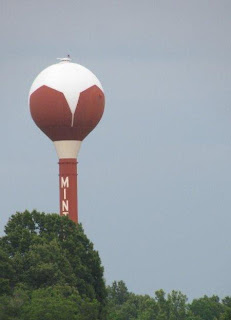
And so to the Delta I went. A cotton boll towers over the landscape, but the fields now are just as likely to be full of rice, often guarded by the hovering skeletons of irrigation systems designed to thwart the blasting temperatures. There are more vacant buildings and more abandoned, once-thriving roadside businesses. There's less activity than I remember.The Delta is now also home to a chemical industry, a high-end manufacturer of commercial-grade cooking appliances, at least two institutions of higher learning, and, a casino. "The Help," a best-selling novel set in Mississippi, will be filmed in Greenwood beginning this summer. None of these places, however, are in the wide open spaces between towns that are shrinking to no more than a couple of convenience stores.
But family is there, shrinking to only a very few of the original 12. So we gathered to reconnect, meet the children--and sometimes grandchildren--of cousins, tell stories, share our music, remember our past.
There, in the middle of it, were the "babies" of the original 12, reveling in the cacophony of voices and laughter and discovery. Here's the life of the party, who will be 80 on her next birthday.
So much has changed. But so much continues through what they all gave to us. We are a rich family beyond measure. And from California, Texas, Missouri, Iowa, and points around Mississippi, the Delta draws us, always, back.
Thursday, June 24, 2010
The eye of the beholder
H.L. Mencken may have called the South the Sahara of the Bozart, but we beg to differ.
Where others see a weathered brick wall, we see the possibilities for a pebbly palette. Art can spring from even the driest wells, as Faulkner brilliantly proved. In our town, built around trains that long since left the station, creativity springs from the familiar and commonplace.
The Coca-Cola mural has been a part of my landscape for so long I don't remember why it's there. Not to advertise the business on whose wall it resides. There once was a grocery store on that corner, and it perhaps dates from a time when groceries were, in fact, within walking distance and not a five-mile drive to the nearest Wal-Mart.
Lest you not feel welcome as you enter our small community, we've also got the art to tell you how happy we are to see you. And, by the way, you can park in the rear for a commercial enterprise that no longer exists.
Making efficient use of the space, we also advertise the annual Labor Day arts festival, letting no one forget we're an oasis of the bozart.
But perhaps my favorite wall mural in our town is one I can't really explain. My cloudy and possibly faulty memory recalls that a class of high school arts students used their talents to give us these images, ostensibly capturing the symbols of our life in small town Mississippi. Make of it what you will.
I see the windmill that has become a city trademark; a blues guitar that no dobut represents one of our city's most famous citizens, Howlin' Wolf; children pointing in wonder at something far beyond my ken.
The fact that I don't understand it is of no concern. That, too, is a symbol for life in our town.
Sunday, June 13, 2010
Endangered Receipts
There was a time when salads almost always started with gelatin. Lime, orange, strawberry, or just plain. 
To serve 100 guests (by special request)

You could top with whipped cream and nuts if you were really extravagant. If you didn't use gelatin, the next choice usually had something to do with fruit cocktail and mayonnaise.
We've come a long way to arugula.
This is on my mind today because I've been cooking all weekend, and because I've just stumbled on an old cookbook hiding amongst the Cooking Lights.
The pages are brown, and the edges flake when I turn it. In its fragile pages are handwritten recipes my mom wanted to keep: a white cake recipe with three tablespoons of B.P. I take that to mean baking powder, something we rarely use today if we can get a self-rising mix. There's a congealed salad recipe that starts with orange jello, also written in her hand. And in the hand of Aunt Lou, long dead, a recipe for Mama Finch's chocolate pie.
My mother was a wonderful cook, and I've inherited her love of food, if not her talent and time. This well-used paperback cookbook, now without its covers, reminds me of the smells and industry of her busy kitchen as she cleverly--and economically--whipped up meals for five hungry kids.
For the young who read this post, who vaguely remember a time before Iron Chef and Hell's Kitchen, here's an ironic reminder of the past. I leave you with a recipe from this venerable book:
To serve 100 guests (by special request)
Three and a half pounds of coffee
Six gallons cocoa made from three gallons each of milk and water and one pound cocoa
Four pounds of loaf sugar
Five gallons of oysters
260 sandwiches made from 16 loaves bread and four pounds butter
30 pounds ham to boil and slice
10 medium-sized cabbages for cold slaw
20 pies
18 quarts ice cream
10 four-pound chickens and 30 heads of celery for salad
Five quarts of dressing for salad
Bon appetit!
Wednesday, June 9, 2010
What can you do with an English major?

Good question, liberal arts fans.
You can teach. If you have patience. Plenty of patience. Tried it. Not a calling.
You can work in publishing. Tried it. Worked for two regional magazines. Loved both, but moved on.
You can hit the political trail. Very few people, it seems, can read and write. Tried it. Loved it. My candidate lost and I was left jobless.
You can become an adult student. Tried it. Loved it, but never finished the Ph.D. (of course, in English). And I so wanted to be hooded. For some reason, people kept thinking I was a lawyer.
You can work for universities or a nonprofit. Tried it. At this point, I think it's pretty much stuck.
And if none of that works, you can become a pretty good sign-holder. For engineering, where there are altogether different opportunities.
Subscribe to:
Posts (Atom)


